Introduction
This document presents the platform model Drizzle AI Systems uses to reason about production AI. It brings cloud foundation, delivery automation, model inference, agent runtimes, security, and observability into one inspectable architecture that remains fully owned by the operating company.
The reference is designed to close the gap between a successful AI workload and an operated product. It makes the important boundaries visible before implementation begins and gives engineering teams a practical starting point for a secure, scalable, and supportable platform.
This post will walk you through the key layers and components of our architecture, explaining how they work together to provide a robust foundation for your AI initiatives.
Core Architectural Principles
The Core Principle of our AI Infrastructure deployments: Secure, Scalable, and Fully owned by you!
Our architecture is not a black box. It’s a transparent, open-source solution deployed on your cloud account. From the Git repository to the cloud resources, you own everything.
Our Pillars
Our architecture is built on four foundational pillars:
- Unified Automation with IaC & GitOps: A single, auditable system for managing your entire platform.
- Optimized for LLM & Agent Serving: High-throughput, low-latency inference for any open-source / commercial model.
- Secure by Design: Essential security best practices are implemented from day one.
- Full-Stack Observability: Complete visibility into performance, cost, and security.
Architectural Layers
The reference platform is structured in logical layers, each building upon the last to create a cohesive, end-to-end system.
The Core Architecture
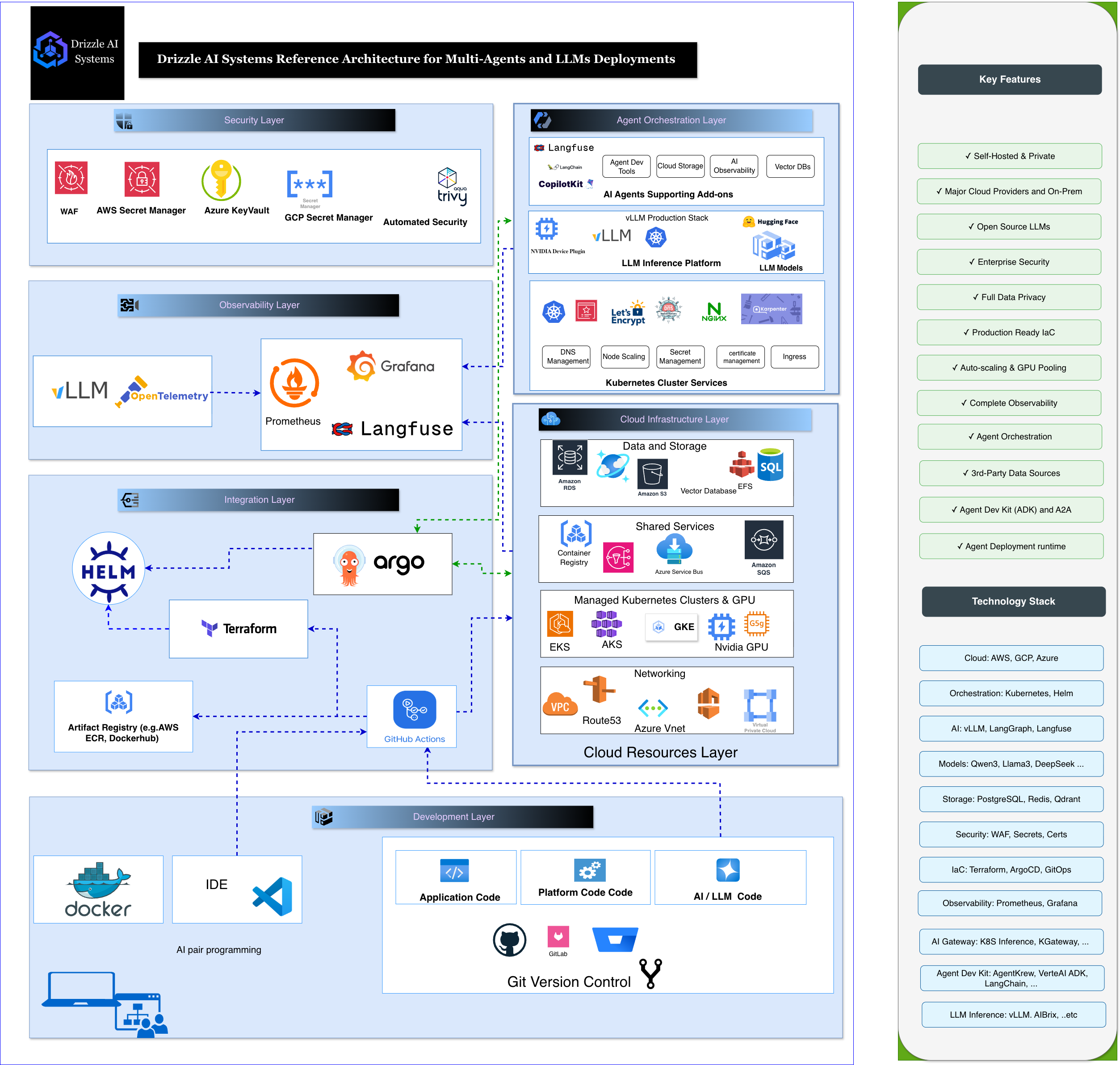
The core blueprint covers the shared platform concerns behind multi-agent systems, model inference, and enterprise AI products. This multi-layer architecture allows organizations to implement scalable AI infrastructure with built-in security, scalability, and governance.
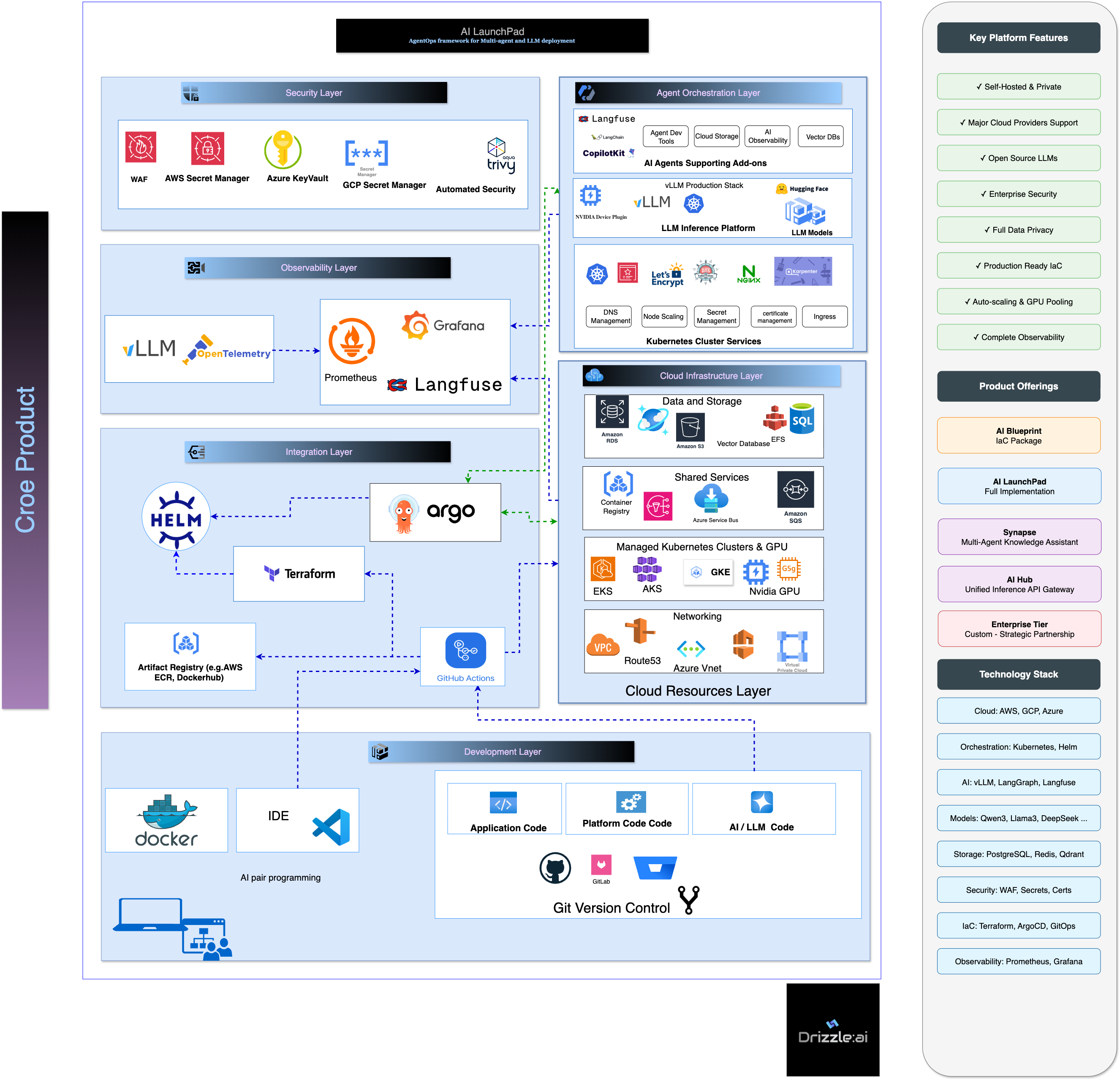
The blueprint consists of six interconnected layers. Security, scalability, and observability are treated as system properties across every layer so the platform can grow with the workload portfolio.
1. Development & Version Control Layer
This is the foundation of all automation and the single source of truth for your entire platform.
- Git Version Control: Developers and AI engineers work in their local IDEs (like VS Code) and commit their Application Code, Platform Code (Terraform/Helm), and AI/LLM Code to a Git repository.
- CI/CD Automation: A push to the repository triggers a CI/CD pipeline (GitHub Actions or GitLab CI) which builds, tests, and packages the code, including creating Docker container images.
2. Integration Layer
This layer takes the version-controlled code and translates it into running infrastructure and applications.
- Infrastructure as Code (Terraform): We use Terraform to declaratively define and provision all necessary cloud resources.
- GitOps (Argo CD): Argo CD continuously monitors your Git repository and automatically deploys any changes to your Kubernetes clusters, ensuring the live state always matches the desired state defined in Git.
- Container Registry: Docker images built by the CI pipeline are stored in a private registry (like Amazon ECR).
- Helm: Kubernetes applications are packaged as Helm charts for repeatable, configurable deployments.
3. Cloud Resources Layer
This is the foundational infrastructure provisioned by Terraform on your chosen cloud provider (AWS, GCP, or Azure).
- Compute & Orchestration: A managed Kubernetes cluster (EKS, GKE, or AKS) with both CPU and GPU-enabled nodes forms the core.
- Networking: A secure VPC (or VNet) provides network isolation.
- Storage: We configure various storage solutions based on need, including object storage (S3), block storage (EBS), and shared file systems (EFS).
- Data and Cache: Managed databases (RDS) and caching layers (Redis) are provisioned to support your AI applications.
4. Agent Orchestration Layer
This is the AI runtime layer, running on the Kubernetes cluster.
- LLM Inference Platform (vLLM): We deploy a production-grade vLLM stack for high-throughput, low-latency model serving.
- Agents DevTools: Suite of AI Agents supporting Add-Ons that provides the tools to build complex, stateful AI agents, e.g LangChain/LangGraph, Co-Pilot kit, Qdrant VectorDB, S3 Vector, …etc
- Kubernetes Cluster Services: Essential production-grade services including auto-scaling with Karpenter, DNS management via External DNS, ingress control and API gateway for secure traffic routing, load balancing, and service mesh capabilities for inter-service communication.
- Security: Automated security is built-in, using tools like Checkov Trivy, External Secret Operator and SOPS.
- Observability: We integrate Langfuse for deep, end-to-end tracing and observability of your LLM applications, alongside Prometheus and Grafana for infrastructure and performance monitoring.
5. Security Layer
This layer implements comprehensive, automated security controls throughout the entire platform, ensuring your AI infrastructure is secure by design.
- Automated Infrastructure Security: Checkov performs static analysis on Terraform code to catch security misconfigurations before deployment, while Trivy scans container images for vulnerabilities in the CI/CD pipeline.
- Secret Management: External Secret Operator (ESO) integrates with cloud-native secret stores (AWS Secrets Manager, Azure Key Vault, GCP Secret Manager) to automatically inject secrets into your applications without storing them in Git or container images.
- Configuration Security: SOPS (Secrets OPerationS) encrypts sensitive configuration files using cloud KMS keys, ensuring secrets are version-controlled safely.
- LLM Guardrails: Automated content filtering and safety checks protect against prompt injection, data leakage, and inappropriate model outputs through integrated safety frameworks.
- Runtime Security: Kubernetes Pod Security Standards and Network Policies enforce least-privilege access and micro-segmentation between services.
- Compliance & Auditing: All security events, access patterns, and configuration changes are logged and monitored through integrated SIEM capabilities for compliance reporting and threat detection.
6. Observability Layer
This layer provides complete visibility into your AI platform’s performance, costs, and security across all components.
- LLM Observability: Langfuse provides deep tracing and analytics for your AI applications, tracking token usage, model performance, conversation flows, and cost attribution across all your LLM interactions.
- Infrastructure Monitoring: Prometheus collects metrics from Kubernetes, applications, and cloud resources, while Grafana provides rich dashboards for real-time visualization and alerting.
- Log Aggregation: Centralized logging with OpenTelemetry and Grafana Loki enables full-text search across all platform logs for debugging and compliance.
- Distributed Tracing: OpenTelemetry provides end-to-end request tracing across your microservices and AI agents.
- Cost Monitoring: Real-time cost tracking and attribution for compute, storage, and AI model usage with automated budget alerts and optimization recommendations.
- Security Monitoring: Continuous security posture assessment with real-time alerts for policy violations, unusual access patterns, and potential threats.
Consultancy Services Implementation
While our architecture provides a robust foundation, we understand that each organization has unique requirements. That’s why we offer specialized consultancy services to help you implement, customize, and optimize your AI infrastructure:
AI/LLM Platform Advisory
Our experts provide strategic guidance tailored to your specific needs, helping you make informed decisions about architecture, technology choices, and implementation approaches.
Multi-Model Customization & Fine-Tuning
We optimize your AI models for peak performance, ensuring efficient GPU utilization and cost-effective deployment for your specific workloads.
AI Native Assessment
We evaluate your current infrastructure and provide a comprehensive roadmap for modernization and optimization, ensuring you get the most value from your AI investments.
Customized Cloud and Agent Platform Architecture
For teams with unique requirements, we design bespoke architectures tailored to your specific AI workloads and business goals.
Legacy Platform Migration
We help you transition from brittle or costly setups to your new cloud-native platform, minimizing disruption and maximizing continuity.
Team Enablement & Training
We provide hands-on training tailored to your stack and roles, ensuring your team has the knowledge and skills to manage and optimize your AI infrastructure.
Conclusion
This layered and open architecture gives teams a faster path to production while preserving control of the cloud resources, platform code, data boundaries, and operating model.
The blueprint reflects practical experience deploying and operating AI systems. Infrastructure as Code, GitOps, and complete observability create a repeatable platform path instead of another one-off workload stack.
Key Benefits of Our Architecture:
- Repeatable Delivery: Use automation and proven platform patterns to shorten the path from architecture to an operated workload
- Full Ownership: Every component runs in your cloud account with complete transparency
- Enterprise Security: Built-in security best practices from infrastructure to application layer
- Scalable Foundation: Designed to grow from prototype to enterprise-scale workloads
- Cost Optimization: Real-time monitoring and optimization recommendations keep costs under control
Whether you are building a first agent workflow or supporting a growing portfolio of AI products, the architecture provides a stable foundation that the operating team can understand and evolve.
If you want to apply this reference to an existing design or a new workload, Drizzle can help identify where the pattern fits, where it needs to change, and which part should be proven first.









Stop Building Infra. Start Delivering AI Innovation.
Your AI agents and applications are ready, but infrastructure complexity is creating bottlenecks. We eliminates these obstacles with enterprise-grade AI infrastructure that seamlessly integrates into your existing cloud environment—transforming months of deployment work into days of rapid delivery.