Fragmented operating context
Accounts, regions, metrics, logs, billing systems, cloud controls, and infrastructure repositories each held a different part of the operational truth.
Client work / Agentic cloud operations
Drizzle built the platform foundation beneath an agentic AI SRE product, connecting authenticated interaction, stateful reasoning, private cloud tools, scoped identity, proactive briefings, and production delivery controls.
The constraint
Dashboards exposed data and generic assistants explained text. The missing capability was an operating system that could establish context, collect evidence, reason through it, and keep authority explicit.
Accounts, regions, metrics, logs, billing systems, cloud controls, and infrastructure repositories each held a different part of the operational truth.
A generic assistant could summarize data, but it could not safely establish tenant identity, select cloud scope, acquire credentials, or prove what it was allowed to do.
Useful autonomy also required memory, typed tools, proactive work, health controls, immutable delivery, rollback, and evidence that the platform could be operated.
Bounded autonomy
The operating model separated what the implementation verified from the broader product workflow and the intended mutation boundary. That distinction kept autonomy credible.
The inspected platform could gather evidence and answer operational questions without receiving mutation authority.
The broader product workflow described how an investigation becomes a reviewable engineering change.
Consequential actions remained behind explicit approval, a privileged execution identity, and an auditable delivery path.
Platform engagement
Drizzle connected product intent, agent runtime, cloud tooling, security, Kubernetes, infrastructure as code, testing, and production diagnostics as one delivery path.
Drizzle defined the tenant, identity, tool, credential, and approval boundaries before increasing agent autonomy.
We implemented an authenticated Agent Gateway, a stateful LangGraph runtime, and a private MCP Gateway with stable cloud tool contracts.
Natural language investigation and scheduled briefings shared the same tenant context, cloud identity, telemetry, and evidence model.
Kubernetes, Terraform, security checks, immutable promotion, smoke tests, health probes, scaling controls, and rollback completed the production path.
Stable contracts for identity, memory, models, tools, cloud access, notifications, and delivery allowed the team to build product capabilities without recreating the platform underneath them.
The system
The public Agent Gateway authenticated the collaboration surface. The private MCP Gateway owned cloud tools and credential use. LangGraph connected them without making the model the security boundary.
Signed requests, OAuth, tenant resolution, streaming, and conversation context.
Explicit state, model policy, tool loop, persistent memory, traces, and evaluations.
Tenant middleware, typed registry, provider adapters, and credential broker.
What Drizzle delivered
The engagement delivered reusable platform capabilities, not a prompt demo or one tightly coupled assistant.
Signed channel requests, OAuth installations, tenant resolution, conversation routing, streaming, and approval surfaces formed one narrow external boundary.
Explicit graph state, parallel tool execution, durable checkpoints, model policy, and graceful tracing degradation made agent behavior inspectable and testable.
A separately deployable gateway exposed a finite registry of typed, tenant aware cloud capabilities over private service networking.
Tenant selection happened before credential creation. AWS role assumption, external identifiers, Pod Identity, and read-only secret mounts constrained authority.
Scheduled cost and reliability analysis published typed events through durable queues so the platform could surface evidence before an engineer asked.
Development, staging, and production promoted the same immutable artifact through security checks, environment smoke tests, and a controlled rollback path.
Evidence ledger
Each number is paired with its evidence class. This preserves what leadership reported while keeping repository observations precise.
Time from the start of the platform build to the reported production readiness milestone.
Growth companies in the reported product trust and adoption footprint.
Typed tools registered in the inspected private gateway across tenant context, cost, documentation, logs, alarms, and metrics.
Python test functions counted across services, shared libraries, agent code, infrastructure helpers, and adapted tooling.
Agent interface, MCP tools, scheduled briefing, and asynchronous notification workloads on one secure platform substrate.
Isolated development, staging, and production paths with immutable artifact promotion and environment specific validation.
Verification scope. The test count is a source count, not a claim that every test ran during preparation of this case study. GCP and Azure runtime parity was not present in the inspected snapshot.
Production operations
Interactive traffic, private tool execution, scheduled analysis, and asynchronous delivery had different scaling profiles but inherited the same identity, telemetry, release, and health controls.
Authenticated chat, OAuth, streaming, tenant context, and persistent conversations.
Private tool execution with typed inputs, bounded results, and tenant scoped credentials.
Scheduled cost and reliability analysis with deterministic calculation metadata.
Typed events, durable queues, retries, correlation identifiers, and channel delivery.
Product impact
The platform turned fragmented operational inputs into explainable investigation while keeping the boundary between evidence, advice, and action visible.
Engagement record
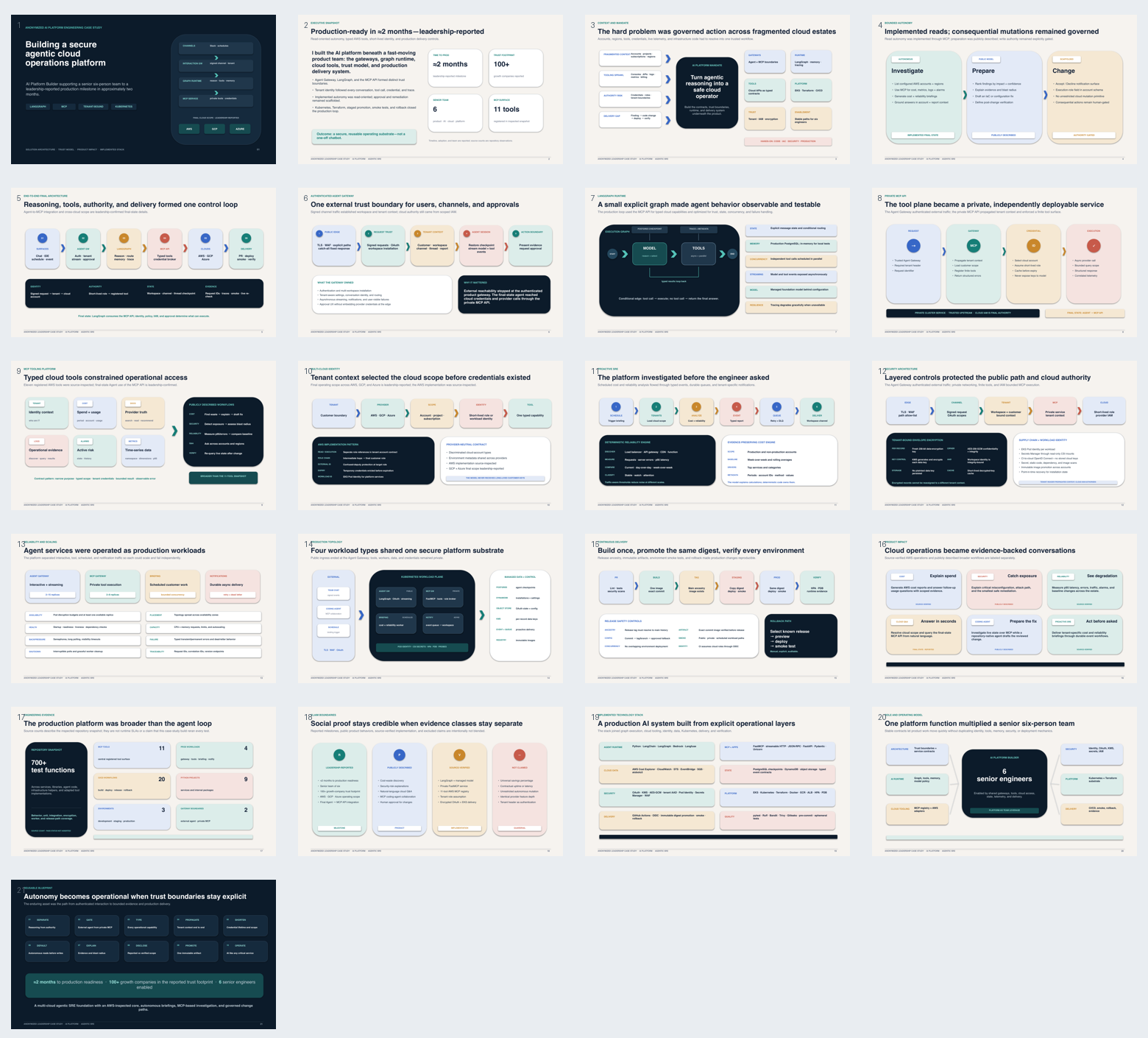
The visual record traces the system from the product constraint to the final operating model, with reported outcomes and inspected implementation kept visibly separate.
Platform leverage
Drizzle built the substrate close to production, then left stable boundaries that the product team could extend across new tools, channels, workflows, and cloud providers.
The runtime, gateways, tooling, infrastructure, and release system remained inside the product engineering boundary.
New agents and channels could consume the same capabilities without importing credentials or provider implementation details.
Health, logs, traces, release summaries, smoke tests, queue behavior, and rollback outcomes exposed the real state of the platform.
The team received a reusable way to distinguish autonomous investigation, reviewable preparation, and governed mutation.
Your agentic platform
Bring the workload, the cloud boundary, and the operating model. We will identify the first governed agent loop worth proving.
Talk to an engineer