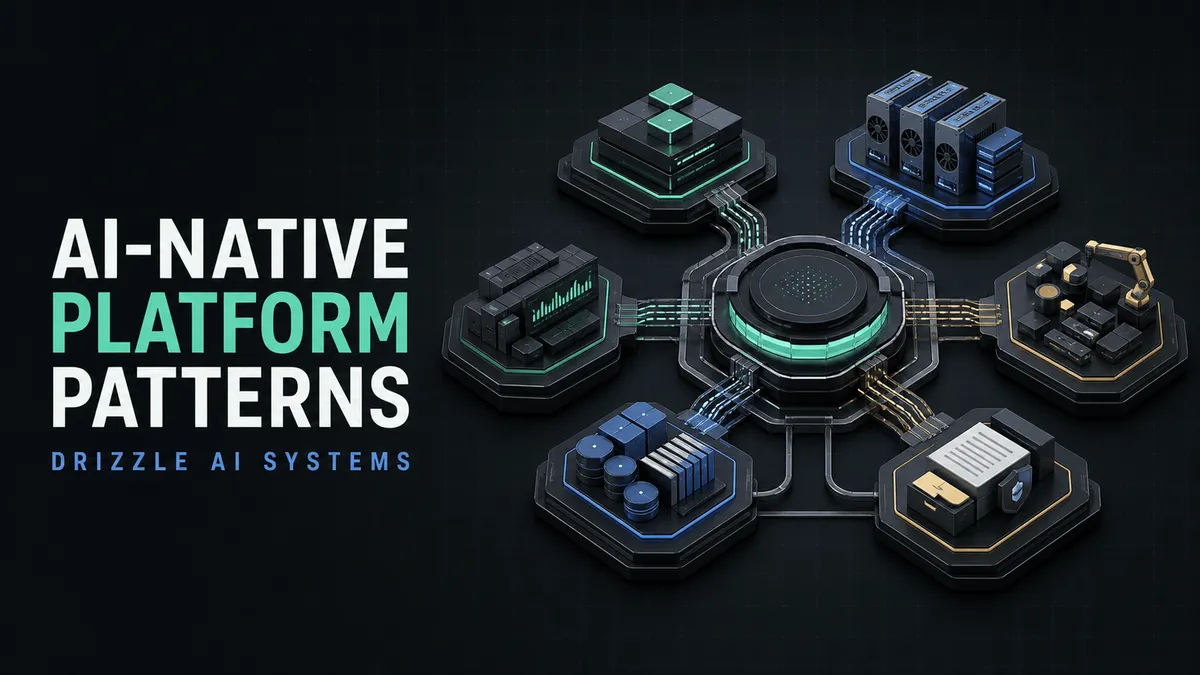
AI changes the unit of operation from software deployment to behavioral outcome.
A conventional platform is designed to answer questions such as: Which version is running? Is the service available? Can we roll it back? Those questions still matter, but they are no longer sufficient.
An AI platform must also answer: Which combination of model, prompt, knowledge, tools, policy, and runtime produced this outcome? Was the outcome acceptable? What did it cost? Which actions did it create? Can we reconstruct the conditions behind it? What happens when one of those dependencies changes without a code deployment?
That shift is the foundation of an AI-native platform.
AI changes the unit of operation from software deployment to behavioral outcome. An AI-native platform does not remove uncertainty from AI. It makes uncertainty visible, bounded, and operable.
The patterns in this article were not designed as an abstract target architecture. They were extracted from recurring decisions encountered while building and operating production AI systems.
The complete AI Platform Pattern Library is the authoritative reference for all eighteen patterns. This article has a different job. It explains why conventional platform thinking must change, which forces create that change, and how the most important patterns compose into an operating model.
The four forces that change the platform
The useful distinction is not whether a platform contains Kubernetes, a vector database, or a model gateway. It is whether the platform is designed around four operational discontinuities.
1. Behavior is assembled, not deployed
What a user experiences may be shaped by application code, a model, system prompt, retrieval policy, tool set, safety configuration, runtime parameters, and live data. These components can change independently.
The source-code commit is therefore not the complete release unit. The platform needs a behavioral release manifest that identifies the configuration behind every production outcome.
2. Compute placement changes product behavior
Model size, accelerator memory, topology, batching, cache locality, queue depth, and traffic shape determine latency, throughput, and cost. They can also influence which model is available or which fallback is selected.
Scheduling is no longer only an infrastructure efficiency concern. It is part of the user experience and product economics.
3. Software can act with delegated authority
An agent can read private data, send an email, change a database row, deploy code, approve a payment, or delete infrastructure. These actions do not carry equal consequence.
Identity, durable execution, sandboxing, policy, approval, and audit must follow every action the agent can create, including browser, shell, filesystem, code interpreter, network, API, and database capabilities.
4. A healthy service can produce an unacceptable outcome
HTTP availability, CPU, memory, and GPU utilization do not tell you whether an answer was grounded, safe, useful, or economical. A technically healthy release can still represent a product regression.
Operational telemetry must connect infrastructure state to evaluation, provenance, release context, cost, and the user-facing outcome.
Aren’t these just good platform engineering?
Many of the foundations are established Platform Engineering, SRE, distributed-systems, and security practices. That is a strength, not a weakness.
AI-native platforms do not invalidate those disciplines. They change the forces those disciplines must respond to.
| Existing principle | AI-specific force |
|---|---|
| Progressive delivery | Behavioral regression can occur when a model, prompt, knowledge source, or policy changes without application code changing. |
| Observability | A successful request can still produce an unsafe, ungrounded, or commercially unacceptable outcome. |
| Resource scheduling | GPU topology, model memory, batching, and cache locality determine both economics and latency. |
| Identity and authorization | Software acts autonomously on behalf of people and services across systems with different consequences. |
| Release versioning | Model, prompt, retrieval, tools, policy, and runtime combine to determine behavior. |
| Circuit breaking | Token, tool, retry, and recursive agent loops can produce nonlinear cost and blast radius. |
The contribution is not a claim that every individual mechanism is new. It is the adaptation of proven mechanisms around a new unit of operation.
A pattern language, not a product catalog
Technology changes quickly. Architectural forces change more slowly.
A governed model gateway may be implemented with different projects. A runtime may use different clouds or inference engines. An evaluation gate will evolve as the product changes. The recurring architecture problem remains: how do you provide shared control without hiding capability, coupling failures, or creating a central bottleneck?
Each Drizzle pattern now contains six parts:
- Context: The conditions that make the decision relevant.
- Problem: The recurring failure the team must resolve.
- Forces: The competing needs that make the obvious answer inadequate.
- Application: Concrete implementation moves.
- Trade-off: The operating cost or limitation introduced by the choice.
- Signals: Evidence that shows whether the pattern is working.
The forces are where architecture becomes real. Consider workload-aware GPU scheduling. Latency wants spare capacity. Utilization wants saturation. Availability wants redundancy. Cost wants fewer accelerators. Model memory and topology constrain placement. Batching improves throughput but can damage latency. The pattern exists to manage that tension, not to recommend a scheduler.
Six domains, one operating model
| Domain | The decision it owns | Patterns |
|---|---|---|
| Platform foundations | Create reusable boundaries from real workload evidence. | AP-01 to AP-03 |
| Inference runtime | Route and schedule models across shared compute. | AP-04 to AP-06 |
| Agent runtime | Control action, identity, state, and recovery. | AP-07 to AP-09 |
| Delivery and assurance | Promote behavioral change with evidence and rollback. | AP-10 to AP-12 |
| Knowledge and data | Preserve authorization, freshness, and outcome provenance. | AP-13 to AP-15 |
| Operations and governance | Explain quality, cost, and failure across the request path. | AP-16 to AP-18 |
This is Pattern Library version 1.0, not a protected set of eighteen. New patterns should emerge when repeated exceptions from operated systems reveal a stable architectural problem. The symmetry is useful for learning, but evidence has priority over taxonomy.
Security is cross-cutting, not a seventh layer
Security, tenancy, provenance, and policy are properties of the complete platform. Putting them in one domain would imply that other domains can delegate responsibility to it.
| Cross-cutting property | Where it becomes concrete |
|---|---|
| Delegated authorization and secrets | Control-plane policy, the governed action boundary, scoped agent identity, and short-lived credentials |
| Prompt injection and tool abuse | Retrieval boundaries, action policy, sandboxing, consequence tiers, and workload limits |
| Tenant isolation | Gateway identity, compute classes, retrieval authorization, cost attribution, and failure containment |
| Supply chain and provenance | Verified model artifacts, reviewed desired state, evaluation evidence, release manifests, and request traces |
| Privacy | Data minimization, trace redaction, controlled cardinality, retention policy, and deletion propagation |
A platform can have strong network policy and still allow an agent to turn untrusted retrieved text into a privileged database action. It can encrypt model traffic and still lose the provenance required to investigate a bad outcome. Security must follow intent, data, identity, execution, and evidence through the entire path.
Three failures that conventional health checks miss
Abstract principles become clearer when the platform appears healthy and the product is not.
The green deployment with worse answers
Imagine model version 27, prompt version 42, and retrieval policy version 6 are promoted together. Availability remains at 99.99 percent. Latency improves. Infrastructure dashboards are green.
A representative evaluation later shows that grounded answers declined by 14 percent because the new retrieval policy favored fresher but less authoritative sources.
The deployment succeeded. The behavioral outcome regressed.
Evaluation before promotion, the data freshness contract, the behavioral release manifest, and end-to-end telemetry make this failure detectable and attributable. Without them, the team sees customer complaints before it sees an engineering signal.
The GPU pool with good utilization and bad economics
The accelerator fleet reports healthy utilization, but interactive requests wait behind batch work. Cold model weights move repeatedly between nodes. A fallback provider is selected more often than intended. P95 latency and cost per accepted answer both rise.
No single GPU metric explains the problem. Workload-aware scheduling, tiered model caching, model gateway attribution, and tenant cost signals expose the complete decision.
The agent retry that repeats a real action
An agent sends a customer email through an external service. The service accepts the request, but the response times out. The agent retries from the beginning and sends the message again.
The model did not hallucinate. The workflow lacked a durable checkpoint, an idempotency key, and a governed action record. Reliability logic created the incident.
These are AI-native failures because behavior emerges across configuration, compute, data, and delegated action. They are also familiar distributed-system failures under new forces.
Six patterns that carry the doctrine
The full library contains eighteen patterns. Six reveal most clearly how the unit of operation changes.
Start with one complete production path
AP-01, Thin Platform Slice, resists both platform overreach and prototype theater. Select one workload with real security, delivery, reliability, cost, and ownership constraints. Carry it through the complete platform path. Generalize only when the next workload exposes repeated demand.
The first platform artifact is not a catalog of services. It is evidence that one real outcome can be delivered and operated.
- 01 Workload
- 02 Paved path
- 03 Production
Schedule the workload objective, not the GPU label
AP-05, Workload-Aware GPU Scheduling, begins with latency, throughput, memory, availability, and interruption tolerance. It then maps those objectives to queues, priorities, isolation classes, hardware, and measured useful work.
The counterintuitive point is that maximum utilization is not always the goal. A latency-sensitive product may need deliberate headroom. A batch workload may accept interruption. The platform should make that economic choice explicit.
- 01 Workloads
- 02 Scheduler
- 03 GPU pools
Put a governed boundary between autonomy and consequence
Reading a CRM record and deleting production infrastructure should never share the same execution policy.
AP-07, Governed Action Boundary, treats a tool as any capability-mediated side effect. That includes APIs, browsers, shells, code interpreters, filesystems, networks, and databases.
Low-risk actions may execute automatically. Medium-risk actions receive policy evaluation. High-risk actions require explicit approval or dual control. Irreversible actions require strongly authenticated human authorization and durable audit evidence.
- 01 Agent intent
- 02 Action policy
- 03 Side effect
Version the behavioral release, not only its parts
AP-15, Behavioral Release Manifest, binds the model, prompt, retrieval policy, tools, safety configuration, and runtime context into one immutable identity. Evaluation and deployment evidence attach to that manifest, and production requests record which manifest was active.
This provides execution provenance and reconstructability. It does not promise that every response can be reproduced bit for bit. Stochastic decoding, nondeterministic kernels, provider-side changes, live tools, mutable APIs, and changing knowledge can make exact reproduction impossible.
The defensible objective is stronger engineering: every outcome maps to the exact behavioral configuration that produced it, and replay is possible against preserved dependencies where available.
- 01 Components
- 02 Manifest
- 03 Outcome context
Observe the outcome from product intent to infrastructure
Your GPU dashboard is green. The API returns successful responses. Customers are receiving worse answers, and the expensive model is being selected twice as often as intended. Is the platform healthy?
AP-16, End-to-End AI Telemetry, connects product intent, gateway decisions, model calls, retrieval, tools, infrastructure, quality, and cost in one traceable request path. The design must control sensitive content, cardinality, and retention from the beginning.
The objective is not more dashboards. It is the ability to explain one outcome.
- 01 Request
- 02 Trace context
- 03 Platform signals
Bound the failure before shared capacity is exhausted
AP-18, Failure Containment by Workload, applies quotas, concurrency, time, token, tool-call, retry, and dependency budgets by workload class. Queues, circuit breakers, bulkheads, and explicit degraded modes stop one recursive or bursty workload from destabilizing the platform.
Hard boundaries can reject legitimate demand. That is the trade-off. Limits should be observable, tied to product consequence, and paired with a reviewed path for temporary expansion.
- 01 Workload
- 02 Boundary
- 03 Shared platform
How the patterns compose around one outcome
The pattern language becomes useful when the boundaries work together.
The control plane owns identity policy, allowable models and providers, routing weights and defaults, quotas, policy definitions, and desired state. The runtime and data planes perform actual per-request admission, routing, failover, load balancing, batching, scheduling, inference, retrieval, and agent execution.
That distinction matters. Routing policy changes through review. Per-request routing must react to live capacity, cache state, latency, failures, and model availability. Git is appropriate for reviewed intent. It is not a high-frequency runtime control plane.
A production request then follows a connected path:
- The product submits the request with tenant, workload, and user context.
- The active behavioral manifest identifies the model, prompt, retrieval policy, tools, and safety configuration.
- Retrieval enforces source permissions and returns evidence with freshness and provenance.
- The runtime applies current admission and routing policy, then schedules suitable compute using workload objectives and cache state.
- If an agent acts, scoped identity, consequence policy, durable state, and approval follow the action.
- One trace connects the user-facing outcome to quality, data, dependencies, latency, infrastructure, and cost.
- Workload boundaries stop retries, long contexts, or recursive actions before they exhaust shared capacity.
- The next release is evaluated, exposed progressively, and rolled back to a complete prior behavioral manifest when signals regress.
No single product provides this platform. The platform exists in the contracts between these decisions.
A practical adoption model
Teams do not need all eighteen patterns before the first workload reaches production.
Prove one outcome
Choose one production workload. Establish identity, reviewed delivery, runtime boundaries, end-to-end telemetry, and ownership. Measure time to production and what a second workload can reuse.
Create shared runtime boundaries
Separate control policy from runtime execution. Add the governed model gateway, workload classes, and cache strategy when several products and models begin sharing infrastructure.
Bind promotion to behavioral evidence
Define the behavioral release manifest, representative evaluations, progressive exposure, and complete rollback target. Add retrieval authorization, freshness, and provenance contracts wherever live knowledge shapes the outcome.
Expand self-service from repeated demand
Turn repeated workflows into paved paths. Introduce cost attribution, consequence-aware action control, and workload containment according to real risk. Convert repeated escape-hatch use into supported platform capabilities.
In one six-month engagement, this approach supported an AI data platform processing about one million events each day, around twenty self-hosted ML and LLM models, ten training pipelines, and dynamic routing across hosted model providers. A team of about ten engineers worked through one operating model across MLOps, data, platform, SRE, full-stack, and AI engineering. The AI data platform case study documents that delivery path.
The complete Pattern Library v1.0
The diagrams below provide a visual index of all eighteen patterns. They preserve the complete map without turning the article into reference documentation. Open any diagram for its context, forces, application guidance, trade-off, and operating signals.
- 01 Workload
- 02 Paved path
- 03 Production
- 01 Control plane
- 02 Contract
- 03 Runtime plane
- 01 Default
- 02 Extension
- 03 Exception
- 01 Products
- 02 Gateway
- 03 Models
- 01 Workloads
- 02 Scheduler
- 03 GPU pools
- 01 Registry
- 02 Node cache
- 03 GPU memory
- 01 Agent intent
- 02 Action policy
- 03 Side effect
- 01 Intent
- 02 Checkpoint
- 03 Action
- 01 User
- 02 Agent identity
- 03 Tool policy
- 01 Commit
- 02 Reconcile
- 03 Runtime
- 01 Candidate
- 02 Evidence gate
- 03 Promotion
- 01 Shadow
- 02 Canary
- 03 Production
- 01 Query
- 02 Retrieval
- 03 Evidence
- 01 Source
- 02 Index
- 03 Retrieval
- 01 Components
- 02 Manifest
- 03 Outcome context
- 01 Request
- 02 Trace context
- 03 Platform signals
- 01 Usage
- 02 Attribution
- 03 Decision
- 01 Workload
- 02 Boundary
- 03 Shared platform
The Drizzle doctrine
An AI-native platform is not defined by how many components it contains. It is defined by whether a team can connect an outcome to the behavioral configuration, evidence, authority, compute, knowledge, and cost that produced it.
The practical sequence is simple:
- Start with one real workload.
- Build the smallest complete production path.
- Treat behavior as the release unit.
- Make uncertainty observable and bounded.
- Expand the platform only from repeated evidence.
That is the shift from deploying AI components to operating AI outcomes.
Explore the complete AI Platform Pattern Library, study the reference architectures, or talk to Drizzle AI Systems about the workload and operating constraints that should shape your platform.